

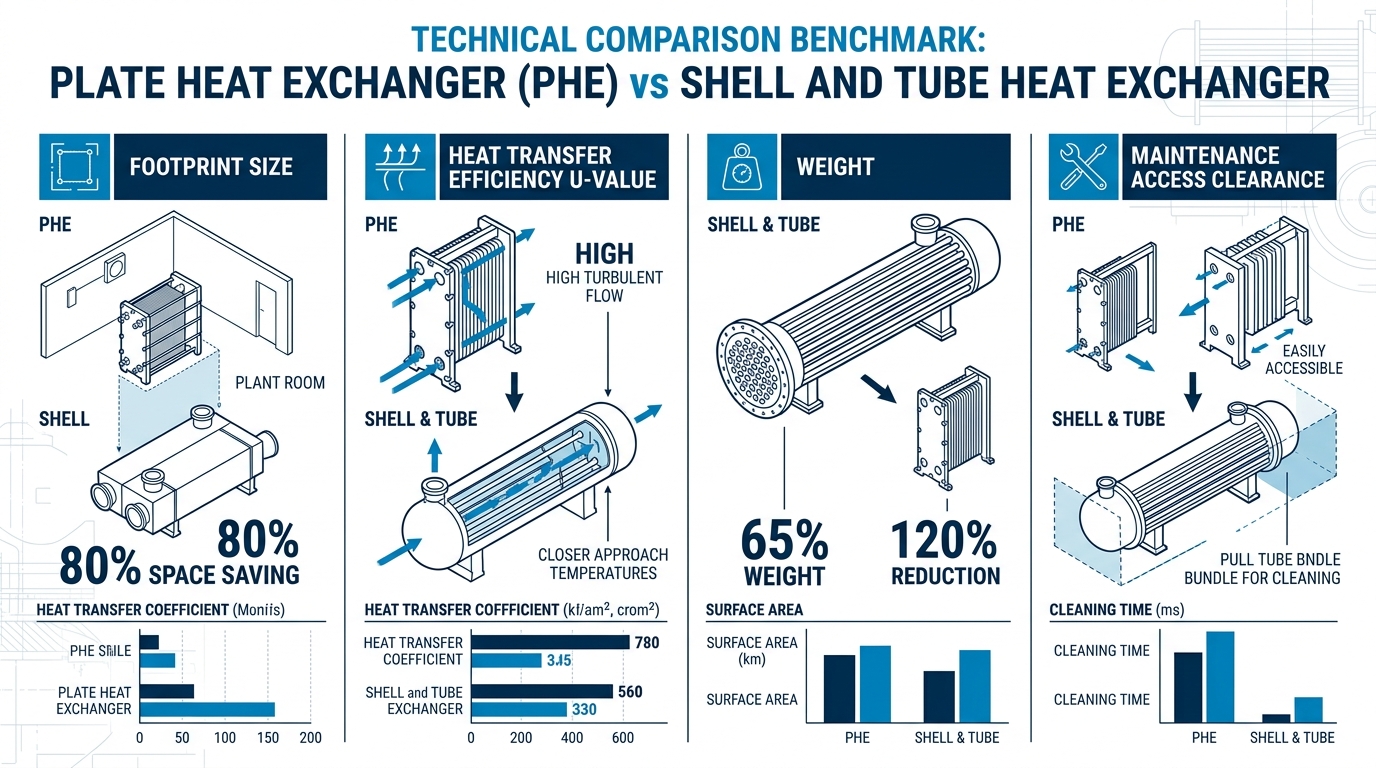
1. Executive Overview: The Shift in Industrial Thermal Strategy
For over half a century, Shell & Tube (S&T) heat exchangers were considered the default solution for high-duty industrial processes. However, increasing energy costs, stringent factory footprint constraints, and aggressive corporate decarbonization targets have driven a systemic transition toward corrugated Plate Heat Exchangers (PHE).
2. Core Engineering Comparison: PHE vs. Shell & Tube
| Engineering Factor | Plate Heat Exchanger (PHE) | Traditional Shell & Tube (S&T) |
|---|---|---|
| Heat Transfer Coefficient ((U)) | 3,000 – 7,500 W/m²·K (Intense wall shear) | 800 – 1,800 W/m²·K (Laminar bypass zones) |
| Approach Temperature ((Delta T_{app})) | Down to 0.5 – 1.0 °C (True counter-current) | Rarely below 3.0 – 5.0 °C (Cross-flow limitations) |
| Physical Weight & Footprint | 70–80% lighter and smaller | Heavy, requires 2x length for tube bundle removal |
| Fouling Factor & Self-Cleaning | High wall shear stress reduces fouling up to 80% | Stagnant eddy zones promote scaling & tube fouling |
| Future Capacity Expansion | Modular: Simply add plates to existing frame | Fixed capacity: Requires complete unit replacement |
3. Capital & Operational Cost Breakdown
Because corrugated PHE plates achieve intense turbulence at Reynolds numbers as low as (Re approx 50) (compared to (Re > 2,000) in smooth shell tubes), the required heat transfer surface area is reduced by up to 75%. This translates directly into substantial savings when utilizing noble alloys such as Titanium Gr. 1, Hastelloy C-276, or SMO 254.