
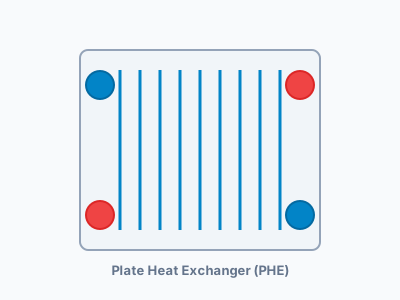
1. Thermodynamic Efficiency: Heat Transfer Coefficients & LMTD
In modern chemical, petrochemical, food & beverage, and water treatment facilities, thermal optimization dictates operating margins and decarbonization metrics. Gasketed Plate Heat Exchangers (PHE) engineered by SonFlow (Denmark) induce intense micro-turbulent fluid dynamics even at low Reynolds numbers ($Re < 50$). This delivers overall heat transfer coefficients ($U$-value) between 3,500 and 7,500 W/m²·K—3 to 5 times higher than conventional Shell & Tube exchangers (600–1,800 W/m²·K).
Governing Heat Duty Equation:
$$Q = U cdot A cdot ext{LMTD} cdot F_t$$
Where $Q$ is heat duty (kW), $U$ is overall heat transfer coefficient (W/m²·K), $A$ is effective surface area (m²), $ ext{LMTD}$ is log-mean temperature difference, and $F_t$ is geometry correction factor ($F_t pprox 0.98$ for PHE vs $0.75 – 0.85$ for Shell & Tube).
Chevron Angle Analysis (30°/60°)
2. Comprehensive Engineering Matrix: PHE vs. Shell & Tube
| Engineering Parameter | Plate Heat Exchanger (SonFlow PHE) | Shell & Tube (TEMA Standard) |
|---|---|---|
| Overall Heat Transfer ($U$-Value) | 3,500 – 7,500 W/m²·K (3–5x Higher) | 600 – 1,800 W/m²·K |
| Close Approach Temperature ($Delta T_{ ext{app}}$) | $le 1.0^circ ext{C}$ (Deep Enthalpy Recovery) | $3.0 – 5.0^circ ext{C}$ |
| Footprint & Physical Volume | 80% Reduction (Mezzanine Compact Skid) | Large Footprint (Requires Tube Pull Clearance) |
| Operational Weight / Hold-up Volume | 75% Lighter (Minimal Liquid Inventory) | Heavy Concrete Foundation Required |
| Modular Capacity Expansion | 100% Flexible (Add Plates to Frame) | Impossible (Requires Full Replacement) |
| Clean-In-Place (CIP) Efficiency | 100% Cleanable with Zero Dead Zones | Prone to Shell-Side Stagnant Fouling |
| High-Alloy Fabrication (Titanium / SMO) | Cost-Effective (Thin 0.5–0.6mm Pressed Sheet) | Prohibitively Expensive Thick Tube Walls |

Compact PHE Skid: Mounted on mezzanine structure without heavy overhead crane infrastructure.

Bulky Shell & Tube: Requires double its physical length in building clearance for tube bundle maintenance.